
Why Directional Trading Fails in Choppy Markets: How Delta-Neutral Execution Captures Yield Without Guessing the Trend
Most traders lose capital trying to predict macro breakouts, getting caught in sudden volatility spikes and stop-hunts. Here is how institutional desks neutralize directional market risk
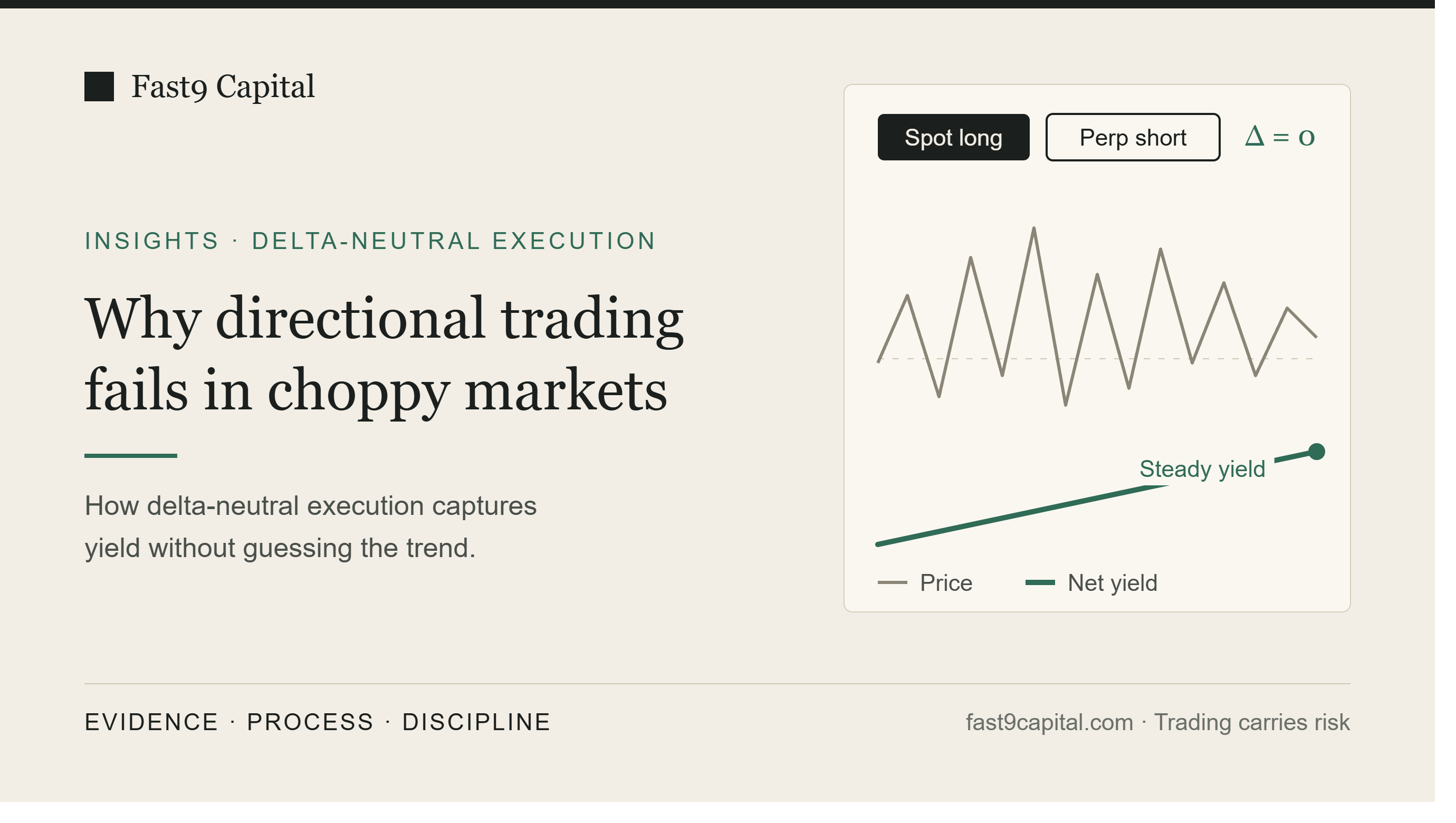
Every retail trader knows the frustration of being right on the macro narrative yet still getting stopped out by intraday noise. In high-volatility regimes, markets spend the majority of their time chopping sideways, liquidating over-leveraged directional bets on both sides of the order book before making a sustained move.
When your portfolio relies solely on price appreciation—buying low and hoping to sell higher—your returns are tethered to market beta. If the market stalls or reverses on an unexpected macro print, your equity curve takes a direct hit.
How Institutional Desks Flip the Equation
Rather than predicting price direction, quantitative desks focus on market neutrality. By constructing a delta-neutral position, you eliminate exposure to directional price swings while isolating structural market inefficiencies as your primary source of return.
In practice, this works through balanced hedging across spot and derivative venues:
Long Spot / Short Perpetual: You hold an underlying asset on a spot exchange while simultaneously shorting an equal notional value on a perpetual futures venue (such as Hyperliquid or Kraken).
Net-Zero Price Exposure: If the asset drops 10%, the loss on your spot leg is offset dollar-for-dollar by the gain on your short perpetual leg. If it rallies 10%, the inverse occurs. Your net directional delta remains near zero.
Harvesting the Carry: Because retail traders overwhelmingly pay premiums to hold leveraged long positions during active markets, perpetual swap contracts frequently trade at a positive funding rate. By holding the short side of the perpetual, you collect regular funding payments directly from the long side—turning market sentiment and leverage imbalances into systematic yield.
Why Execution and Risk Architecture Matter
While the concept of delta-neutral carry is straightforward, executing it profitably at scale requires strict quantitative discipline:
Execution Slippage & Latency: Entering or exiting both legs simultaneously without legging risk requires automated order-book routing across liquidity venues. Even a few basis points of slippage can erase days of funding yield.
Dynamic Margin Buffers: During violent short squeezes, the short perpetual leg requires sufficient collateral to prevent liquidation before the spot leg can be rebalanced. Institutional engines continuously monitor collateral ratios and enforce automated drawdown limits to protect the High-Water Mark.
Regime Filtering: Funding rates fluctuate. Systematic strategies dynamically scale exposure up when carry spreads widen and reduce allocation when funding turns flat or negative.
Put Quantitative Execution to Work
You do not need to stare at charts all day or gamble on the next breakout to generate consistent portfolio growth. At Fast9 Capital, our automated execution infrastructure handles multi-venue hedging, collateral balancing, and real-time risk management around the clock.
Ready to move beyond directional guesswork? Create an account on the Fast9 Capital Investor Portal to explore our systematic strategies, review live performance metrics, and see how market-neutral allocation can anchor your portfolio.