
Delta-Neutral Strategy: A Beginner’s Guide
Delta-neutral trading aims to earn returns without betting on whether markets go up or down. Here is how it works.
Most investors ask one question: will the market go up or down? A delta-neutral strategy is built to make that question matter much less.
What does “delta-neutral” mean?
Delta measures how much a position’s value changes when the price of the underlying asset moves. If you buy an asset, your delta is positive. If you short it, your delta is negative.
A delta-neutral portfolio combines positions so that these exposures cancel out. The portfolio’s value then shouldn’t move much when the market moves in either direction. The goal is to earn from something other than price direction.
A simple example
Say you buy $10,000 of an asset in the spot market. If the price falls 10%, you lose $1,000.
Now open a short position of the same size in a futures contract on that asset. If the price falls 10%, your spot position loses $1,000 and your short position gains about $1,000. The two legs offset each other, and your net exposure to direction is close to zero.
The trade is no longer a bet on price. The return comes from other sources, described next.
Where does the return come from?
Because direction is hedged out, delta-neutral strategies look for other sources of return, such as:
- Funding rates: in perpetual futures markets, one side of the trade periodically pays the other. A hedged position can collect these payments when the rate is in its favor.
- Basis: futures often trade at a different price from spot. A hedged position can earn that gap as the two prices converge.
- Pricing inefficiencies: small, temporary differences between related instruments, such as FX pairs or equity index futures, can be captured when the long and short legs offset each other.
None of these depends on guessing the next market move. That is why delta-neutral strategies can behave differently from “buy and hope” investing.
Why traders use it
- Less dependence on direction. Returns aren’t tied to the market going up.
- Better fit for choppy or sideways markets. Directional traders can lose money in ranging markets through false breakouts and stop-outs.
- Lower volatility. Hedged positions tend to produce smoother results than outright directional bets.
- Rules-based execution. The approach suits systematic trading, where position sizes and limits are set in advance rather than by gut feeling.
What are the risks?
Delta-neutral does not mean risk-free. Be clear about the limits:
- Imperfect hedges. The two legs may not move in perfect lockstep, which leaves “basis risk.”
- Funding rate changes. Rates can turn against the position and reduce or reverse returns.
- Margin and liquidity. Hedged positions still need collateral. Sudden volatility can force a position to be closed at a bad time if margin is thin.
- Execution costs. Fees, slippage and spreads can eat into small edges.
- Counterparty and platform risk. The exchange or broker holding your positions matters.
This is why risk management matters as much as the strategy itself. Position limits, collateral buffers and a cash reserve are part of the design, not an afterthought.
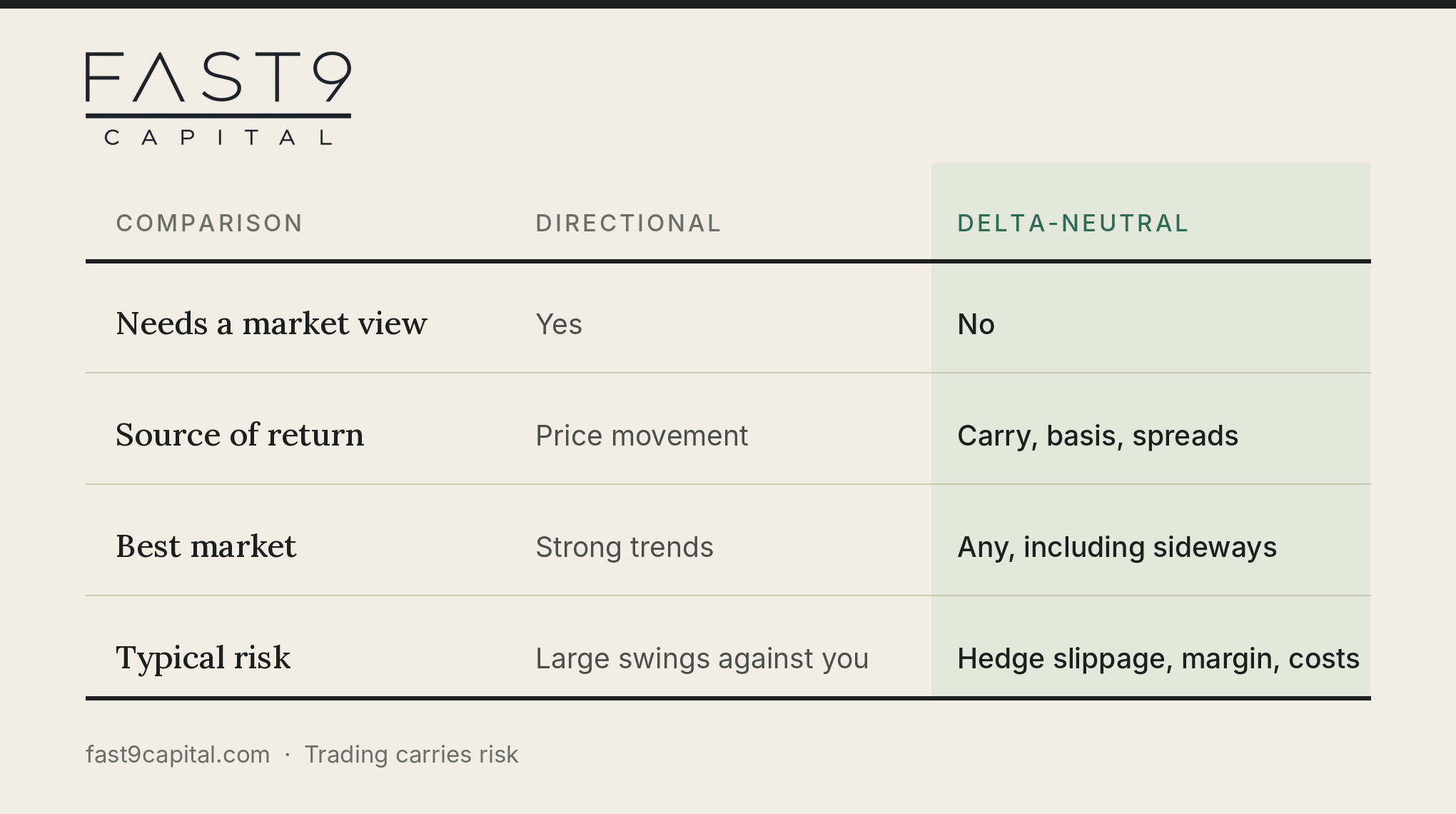
Delta-neutral vs. directional trading
How Fast9 Capital uses delta-neutral trades
At Fast9 Capital, delta-neutral structures make up 40% of the portfolio. They run alongside a 40% statistical arbitrage sleeve and a 20% cash and risk-offset reserve. The delta-neutral sleeve uses offsetting long and short legs so the book earns from pricing inefficiencies rather than market direction, and every position is sized by rule rather than opinion.
Objectives are strategy targets, not guarantees of future results.
Key takeaways
- Delta-neutral means offsetting positions so net exposure to price direction is close to zero.
- Returns come from carry, basis and pricing inefficiencies, not from predicting the trend.
- It can suit sideways or volatile markets, but it still carries real risks.
- Good risk management, including margin buffers and position limits, is what makes it work over time.
FAQ
Is a delta-neutral strategy risk-free?
No. It reduces directional risk, but hedge slippage, margin pressure, changing funding rates and costs can still cause losses.
Do I need to predict the market?
No. The strategy aims to earn from spreads and carry rather than from price direction.
Does it work when the market is falling?
Because the long and short legs offset, direction matters much less. Sharp volatility can still put pressure on margin and execution.
Is it suitable for beginners?
The idea is simple, but running it well needs strong execution and risk controls. Many investors prefer to access it through a managed, rules-based program.
Trading carries risk. This article is for education only and is not financial advice. Past performance and target metrics do not guarantee future results.