
Navigating High-Volatility Regime Shifts: How Quant Models Adapt When Directional Indicators Breakdown
When rapid regime shifts and volatility spikes invalidate traditional directional long/short indicators, systematic trading desks shift focus from price forecasting to structural execution mechanics.
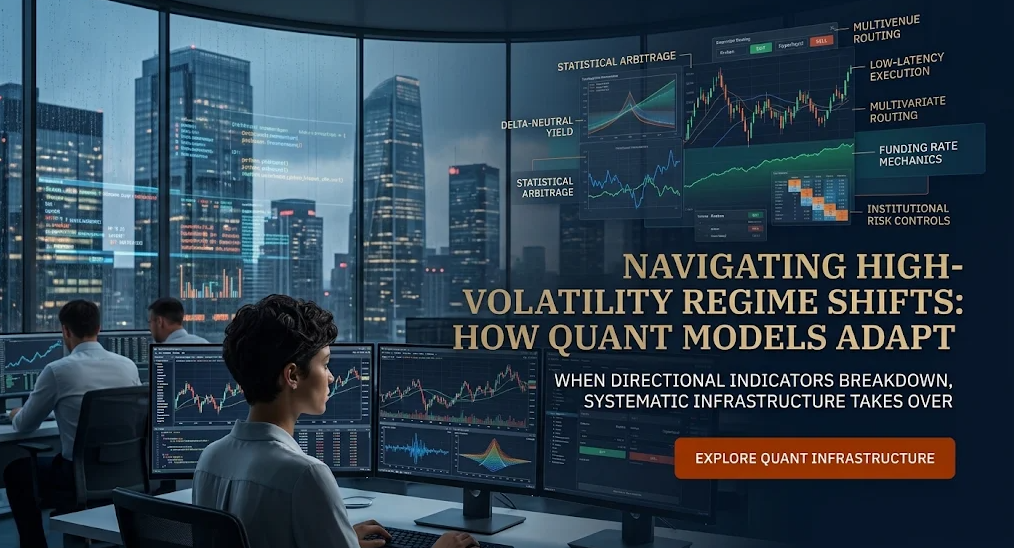
In hyper-liquid digital asset and global derivative markets, directional trading strategies regularly hit structural walls. Sharp regime shifts, sudden liquidity drains, and rapid volatility spikes can quickly invalidate traditional technical indicators, leading to severe slippage, stop-out cascades, and whipsaw losses for directional long/short traders.
When directional signals lose their statistical edge, systematic and quantitative market participants shift their focus away from predicting price trajectory. Instead, they pivot to market-neutral structures, cross-venue spread dynamics, and execution infrastructure—harvesting yield and statistical mispricing regardless of market direction.
1. The Breakdown of Directional Edge in Choppy Regimes
During periods of market consolidation or macroeconomic uncertainty, trend-following momentum models suffer from false breakouts, while mean-reversion models risk getting caught in one-sided liquidation squeezes.
Directional trading in these environments carries three distinct structural risks:
Asymmetric Liquidation Risk: Order book depth thins out rapidly near key support and resistance levels, leading to aggressive market orders sweeping order books.
Funding Rate Drag: Holding long or short perpetual futures positions during extended consolidation can result in negative carry as funding rates flip unpredictably.
Execution Slippage: High-volatility shifts widen the bid-ask spread across venues, significantly increasing entry and exit friction.
To navigate these regime shifts, institutional quantitative desks rely on strategies designed to decouple portfolio returns from spot price direction.
2. Quantitative Countermeasures: Delta-Neutral & Spread Arbitrage
Rather than guessing the next leg of market expansion, systematic frameworks focus on mathematical relationships between correlated instruments and venues.
A. Perpetual Funding Rate ArbitragePerpetual swap contracts depend on periodic funding rate payments to anchor contract prices to underlying spot markets. When market sentiment leans heavily bullish or bearish, funding rates expand.
Quantitative traders take advantage of this by establishing delta-neutral positions—for example, holding a long spot (or synthetic long) position while simultaneously opening a matching short perpetual futures position.
Mechanism: The portfolio delta is net-zero, neutralizing exposure to price movements.
Yield Source: The trader continuously collects positive funding rate payouts from over-leveraged market participants.
Liquidity is fragmented across major decentralized order books (such as Hyperliquid) and centralized venues (such as MetaTrader-connected liquidity pools or Kraken).
During rapid volatility spikes, price discovery occurs at different speeds across these execution venues. Statistical arbitrage algorithms monitor these temporary mispricings in real-time, executing offsetting buy and sell orders across exchanges when price spreads diverge beyond statistical norms and closing them as prices revert to parity.
3. Why Execution Infrastructure Dictates Realized Edge
In quantitative trading, a theoretical mathematical edge means nothing without optimal execution routing. Microsecond delays, latency spikes, or inefficient clearing models can transform a profitable statistical trade into a net loss after slippage and fees.
Executing delta-neutral and arbitrage strategies at scale requires:
Low-Latency Order Routing: Automated API connectivity capable of sub-millisecond execution across multiple liquidity venues simultaneously.
Institutional Liquidity & Tight Spreads: Direct access to deep liquidity pools to minimize market impact when rebalancing hedges.
Automated Risk Management Controls: Real-time drawdown limits, margin utilization checks, and automated emergency unwinds to protect capital during anomalous market shocks.
Transparent Clearing & Regulatory Frameworks: Counterparty trust and capital safety backed by robust regulatory clearing environments (such as MISA frameworks).
Bridge Your Trading Strategy with Fast9 Capital
Systematic trading eliminates emotional bias, but it demands an environment built specifically for speed, precision, and multi-venue connectivity.
At Fast9 Capital, we provide the quantitative infrastructure, institutional-grade execution routing, and robust clearing architecture needed to execute complex statistical arbitrage and delta-neutral strategies seamlessly. Whether you are scaling automated quantitative models or seeking low-latency liquidity across global crypto and derivative venues, our platform provides the execution edge your strategies require.